6061 is the everyday engineering alloy of the aluminium world. It is strong, machines cleanly, welds well and resists corrosion, which is why it turns up in machined parts, vehicle components, frames and fixtures across New Zealand.
Altus® Industrial Aluminium supplies 6061 plate, rod and bar with fast nationwide delivery available anywhere in the country, and cuts in-house for one-off cuts or full project runs.
What is 6061 aluminium?
6061 belongs to the 6000 series of aluminium alloys, alloyed mainly with magnesium and silicon. It is heat treatable: its strength comes from controlled heating and ageing, which is what the "T" in its temper code describes.
Once heat treated, 6061 is much stronger than the softer alloys used for sheet metal work, while still machining cleanly and welding well. Like all aluminium, it weighs about a third as much as steel.
T6, T651 and T6511: what the tempers mean
| Temper | What it means | Why it matters |
|---|---|---|
| T6 | Solution heat-treated, then artificially aged | Full strength for the alloy |
| T651 | Heat-treated as T6, and stress-relieved by stretching | Stays flatter when machined |
| T6511 | As T651, with minor straightening after stretching | Common on extruded rod and bar |
Which temper should I choose? All three have the same strength. For machined plate, choose T651: relieving the internal stresses keeps the plate flatter as material is cut away. Rod and bar are commonly supplied as T6511.
Typical properties
Typical values for 6061-T6 are a tensile strength of about 310 MPa and a yield strength of about 275 MPa. Minimum values vary with product form and thickness, so check the mill certificate for your material.
Where 6061 is used
- Engineering and CNC-machined components
- Jigs, fixtures and machine frames
- Vehicle and trailer components
- Robotics and automation
- Brackets and structural fittings
Is 6061 suitable for precision machining?
Yes. 6061 cuts cleanly in milling and turning, which is why it is a first choice for CNC-machined parts. For machined plate, choose T651: it has been stretched to relieve internal stress, so it stays flatter as material is removed. 6061 plate is usually supplied in thicker sizes and used for machined components such as engine mounts and equipment.
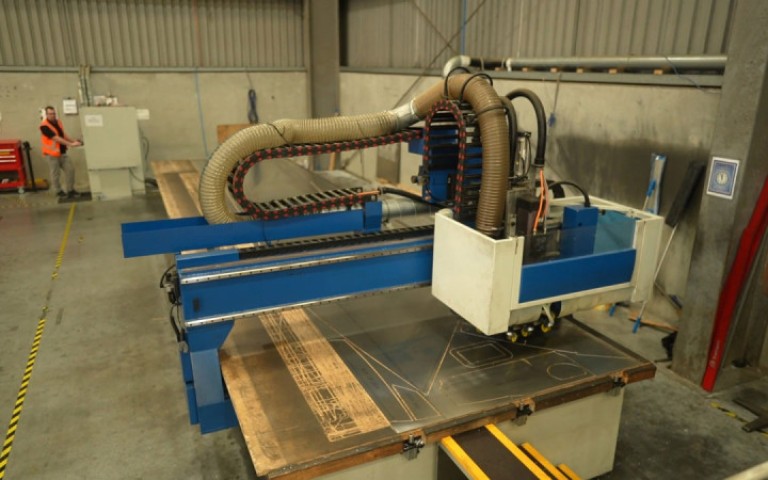
Where a part needs an accurate, repeatable profile cut from plate, Altus Industrial also offers CNC routing.
Is 6061 marine grade?
6061 resists corrosion well, but it is not usually the first choice for hulls or for parts that sit in seawater. 5052 is a marine grade and suits parts that are washed down and kept out of the water, such as trailer boats, but it is not made for permanent immersion in seawater. For hulls and parts that sit in seawater, choose 5083. 5083 is one of the highest-strength non-heat-treatable aluminium alloys, with excellent welding properties, and Altus Industrial offers Lloyd's-certified 5083 sheet and plate where certification is required.
Around boats and coastal work, 6061 is usually chosen for machined fittings, frames and brackets, where its strength and machinability matter most.
6061 or 5083: which should I use?
| 6061 | 5083 | |
|---|---|---|
| Where its strength comes from | Heat treatment (T6 tempers) | Its alloying; it is not heat treatable |
| Best at | Machining, high strength | Corrosion resistance in seawater, welding |
| After welding | Loses part of its T6 strength near the weld | Excellent welding properties |
| Common uses | Engineering, machinery and machined components | Marine, transport and demanding applications |
In short: choose 6061 when the part will be machined or needs high strength, and 5083 when it will be welded into a structure that lives near or in seawater. For the full comparison of 5005, 5052, 5083 and 6061, read how to choose aluminium sheet or plate.
6061 or 6060 and 6063?
These are extrusion alloys with lower strength and a better surface finish, used for window frames, trims and architectural sections. Choose 6061 when strength and machinability matter more than appearance.
Welding 6061
6061 welds well with standard MIG and TIG methods, but the heat softens the metal near the weld and it loses part of its T6 strength there. Allow for this where welds carry load.
Finishing 6061
6061 anodises well for protective finishes. For a bright, highly decorative anodised look, the extrusion alloys 6060 and 6063 usually give a better result. 6061 also powder coats well. For help choosing a finish, read powder coating or anodising.
Can 6061 be cut to size?
Yes. Altus Industrial cuts 6061 plate, rod and bar in-house, from a single cut to a full project run, and offers CNC routing for profile-cut plate. Send the team your sizes and quantities, and where it needs to go. Fast nationwide delivery is available anywhere in the country. Before sending a profile job, read CNC routing aluminium: what you need to know before sending a job for cutting.
Where to buy 6061 aluminium in New Zealand
Altus Industrial supplies 6061 plate from 12 mm to 304.8 mm thick, mill finish, in sheets up to 1,550 mm wide and 3,650 mm long. Plate from 12 to 152.4 mm is T651, and 203, 254 and 304.8 mm are T6. Other sizes and thicknesses can be indented, and the team can confirm what is in stock.
Rod and bar are also available. Contact the team for sizes, cutting and delivery:
- Auckland Trade Centre, East Tāmaki
- Hamilton Trade Centre, Burbush
- Christchurch Trade Centre, Halswell
See the full plate table and catalogue on the sheet and plate page, or call 0800 77 77 44.
Frequently asked questions
What is the difference between 6061-T6 and 6061-T651?
They have the same strength. T651 has also been stretched to relieve internal stress, so it stays flatter when machined. Choose T651 for machined plate.
Can 6061 aluminium be CNC machined?
Yes. It is strong and cuts cleanly in milling and turning. For machined plate, choose T651, which stays flatter as material is removed.
Is 6061 aluminium marine grade?
It resists corrosion well, but for hulls and parts that sit in seawater choose 5083. 5052 is a marine grade, but it is not made for permanent immersion. 6061 is usually used for machined fittings, frames and brackets.
Should I use 6061 or 5083?
Choose 6061 for machined parts and high strength. Choose 5083 for welded structures near or in seawater, where its corrosion resistance and welding properties matter more.
Does welding weaken 6061?
6061 welds well by MIG or TIG, but the heat reduces strength near the weld. Allow for that in designs where welds carry load.
Can 6061 plate be anodised?
Yes, it anodises well for protective finishes. For a bright, decorative anodised look, 6060 or 6063 usually gives a better result.
Can I get 6061 cut to size?
Yes. Altus Industrial cuts 6061 plate, rod and bar in-house, and offers CNC routing for profile-cut plate.
Where can I buy 6061 aluminium in New Zealand?
Altus Industrial supplies 6061 plate, rod and bar with fast nationwide delivery available anywhere in the country.
What thicknesses of 6061 plate are available?
Altus Industrial supplies 6061 plate from 12 mm to 304.8 mm thick. Other sizes and thicknesses can be indented.